Arched Shelving and the Art of Display
An arch costs you the corners of the top shelves. Here is the usable-space maths and how to style the shape properly.
An editorial piece on proportion and arrangement, with our own geometry on usable shelf width. Fixings and stability depend on the product and the wall, so follow the maker's instructions.
The arch came back from architecture into furniture, and it has been on every shelving unit sold for about three years. It is a genuinely good shape in a room full of right angles. It also costs something, and almost nobody says what.
The arch takes the corners
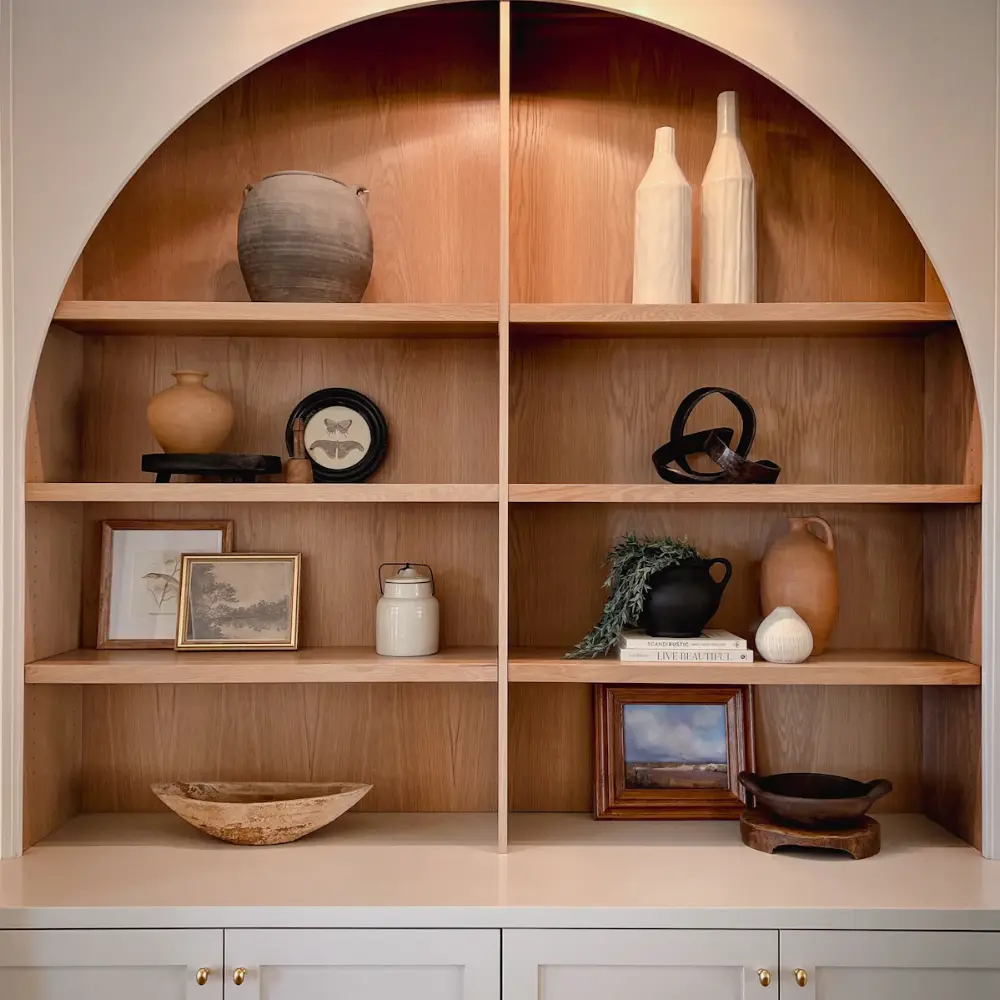
On a rectangular unit, every shelf is the full width. On an arched one, the top shelves are cut by the curve, so the usable length drops as you go up.
Take a unit 36 inches wide with a semicircular top. At the very top of the arch the usable flat width is near zero, and the shelf one step down might offer 20 inches of the 36, which is about 55% of the full width. So the two uppermost shelves in an arched bookcase hold a fraction of what the same shelves would hold in a square one.
That is not a fault. It is the trade, and it is the reason arched units look lighter. You are paying in storage for the visual relief at the top, which is a reasonable thing to buy as long as it is a decision rather than a surprise.
The practical consequence is to buy arched shelving for display and rectangular for books. A row of paperbacks needs full-width shelves at every level, and an arch will leave you with two shelves that fit three books and a vase.
Style the shape, not against it
The curve wants to be read. Arranging objects in a flat line across every shelf fights it, while letting the content step down toward the middle at the top echoes the shape and the whole unit reads as one piece.
- Put the tallest object just off centre on the lowest shelf, so the heavy weight is at the bottom where the eye expects it.
- Use the narrowing top shelves for one small object each rather than trying to fill them, since the arch is doing the decoration there.
- Keep a curve somewhere in the contents. A round vase or a bowl in an arched bookcase connects to the frame in a way a stack of square books never will.
- Leave the shelf directly under the apex emptiest of all, as that is where the shape is most visible and clutter hides it.
Where it belongs
Arched shelving is at its best on a wall where the arch has room above it, which usually means a ceiling that is not immediately pressing down on the curve. A tall arch under a low ceiling looks squeezed and the shape stops working.
It also suits alcoves and chimney recesses extremely well, because the arch softens a hard rectangular opening without any building work. In a plain square room it is often the only curved line in the whole space, which is exactly why it reads as deliberate.
The restraint that makes it work
One arched piece per room. The shape is strong, and two arches in a sightline start to look like a theme rather than a choice.
And keep roughly a third of the total shelf area empty. Arched shelving is display furniture by geometry, since the top of it cannot hold much anyway, so filling the lower shelves to capacity undoes the lightness you paid for at the top.
An editorial piece on proportion and arrangement. Usable shelf width figures are our own geometry based on a semicircular top on a 36 inch wide unit and will differ with any other arch profile or width. Stability, fixings and load limits depend on the specific product and wall.