Simple Pine Beds That Age Beautifully
Pine is soft by the numbers and that is why it ages well. Janka figures, the dent question and what to check before buying.
Janka hardness figures below are quoted from published typical side-hardness values, which the source describes as averages. Individual boards vary. No specific bed has been tested by us.
Pine has a reputation problem. It is the wood of student furniture and flat-pack, and in a market where every listing says solid hardwood, saying solid pine sounds like an admission.
The numbers do confirm it is soft. They just do not say what people assume they say.
What the hardness figures actually show
Published Janka hardness values put eastern white pine at 380 lbf. White oak sits at 1,360 and hard maple at 1,450. So white oak is 257.9% harder than eastern white pine by that measure, which is a large gap and worth knowing.
But pine is not one wood. Southern yellow pine in its longleaf form is published at 870 lbf, and loblolly and shortleaf at 690. Longleaf is 128.9% harder than eastern white pine, which means the softest and hardest pines in common use are further apart from each other than people realise.
A pine bed made from southern yellow pine is a structurally different object to one made from eastern white, and almost no listing tells you which you are getting.
Why softness is the point
A soft wood takes a mark. On a floor that is a problem, which is why Janka hardness became a flooring number in the first place. On a bed frame it is mostly irrelevant, because nobody walks on a headboard.
What softness gives you instead is a surface that records use gently. Dents go rounded rather than sharp. Edges wear smooth where hands grip. The colour deepens from pale straw toward honey over years, and unlike a stained hardwood it does so unevenly, which is what makes old pine look like it belongs somewhere.
Oak ages too, more slowly and more uniformly. The choice is between a wood that looks nearly new for twenty years and one that looks like itself after five. Neither is better. They are different intentions.
What to check before buying
- Ask which pine. If the seller cannot say, assume the softer end and price it accordingly.
- Look at the joinery rather than the wood. In a soft timber, screws into end grain loosen over time, so mortise and tenon, dowels or bolted rails matter more here than in oak.
- Check the slat count and the centre support, since a soft frame with too few slats is where a pine bed earns its creaking reputation.
- Avoid heavy stain. Pine takes stain blotchily because of its resin content, and a dark stained pine bed is usually hiding the grain rather than showing it.
- Prefer oil or wax to lacquer. A lacquered surface chips and cannot be touched up, while an oiled one can be refreshed with a cloth in ten minutes.
Living with the dents
Pine will mark in the first year. A belt buckle, a vacuum cleaner, a dropped book. Anyone who needs furniture to stay unmarked should buy maple and stop reading here.
The useful detail is that shallow dents in softwood often lift with steam, because the fibres are crushed rather than cut. A damp cloth and an iron will raise a surprising amount of damage that would be permanent in a harder timber. That is a genuine advantage of softness and nobody mentions it in the listings.
The case for the plain version
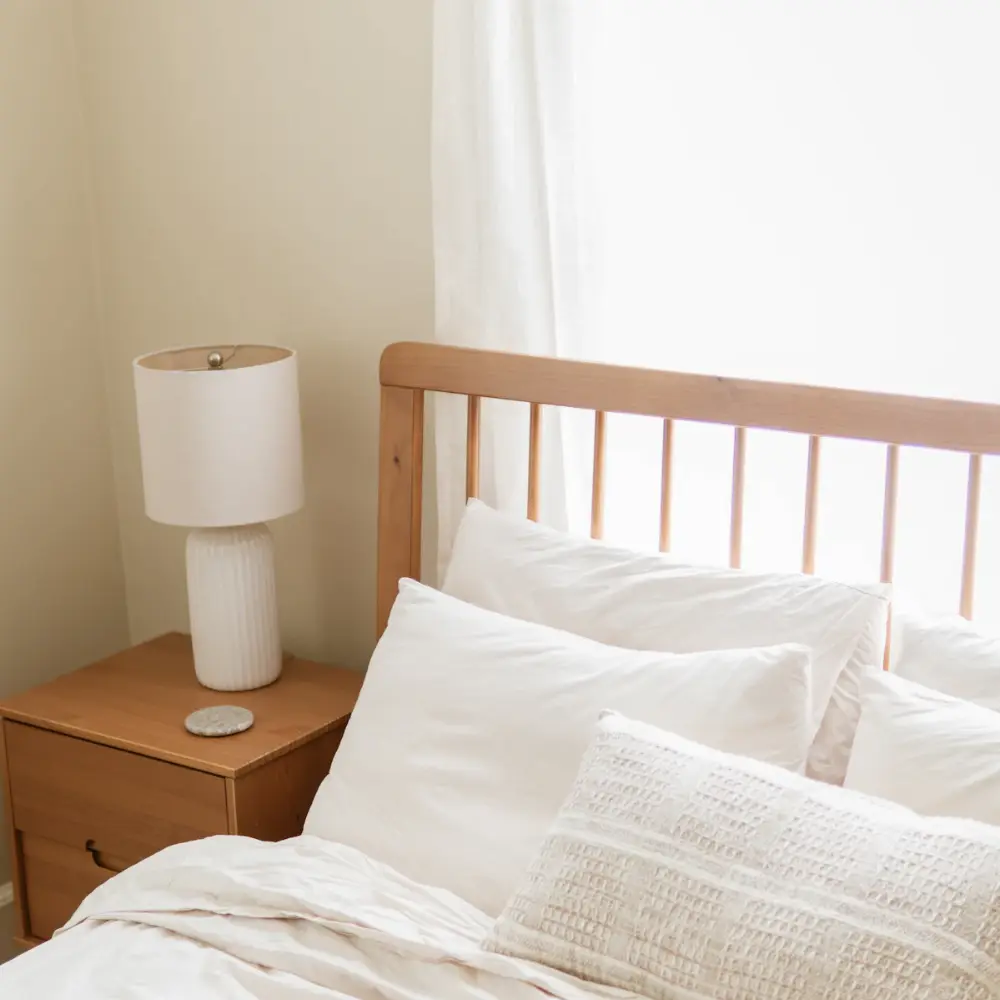
Pine suits simple shapes. Turned spindles and heavy mouldings in a soft pale wood look like an imitation of something else, while a plain square-sectioned frame in oiled pine looks like what it is.
Buy the simplest one available, in the hardest pine the seller will name, finished with oil rather than lacquer. It will cost a fraction of oak, it will mark within months, and in ten years it will look better than it does on the day it arrives. Very little furniture at that price can make the same claim.
Janka hardness values for eastern white pine, southern yellow pine, white oak and hard maple are quoted from published typical side-hardness figures described by the source as averages. Percentage comparisons are our own calculations from those figures. Steam dent removal and finish behaviour are general woodworking practice rather than tested results, and results vary by board and finish.