A Cozy Green Bedroom for Slow Mornings
Green behaves differently depending on which way the room faces. How to pick one that stays warm at seven in the morning.
An editorial piece on colour and light. Paint behaviour varies enormously by product, room and window, so sample before committing. No specific paint has been tested by us.
Green is the colour people choose when they want a room to feel calm, and it is also the colour that most often goes wrong. The swatch looks like moss in the shop and like hospital corridor on the wall, and nobody can explain the gap until they stand in the room at a different hour.
The explanation is almost always the direction the window faces, and it is worth sorting out before any paint is bought.
Which way the room faces decides the green
North-facing rooms get cool, indirect light all day. A cool green with blue in it, which includes most of the fashionable mid greens, will read grey and slightly institutional in that light. The same paint in a south-facing room looks exactly like the swatch.
So in a north-facing green bedroom, go warmer than feels right. Olive, moss and anything with yellow underneath it holds its character when the light is flat. In a south or west-facing room you have far more freedom, and a cooler green will stay green even in strong afternoon sun.
Paint a large sample directly on the wall rather than on card, and look at it at seven in the morning, at midday and under the bedside lamp. A bedroom is used mostly at the two ends of the day, which is exactly when most people never check the colour.
Why sage keeps winning
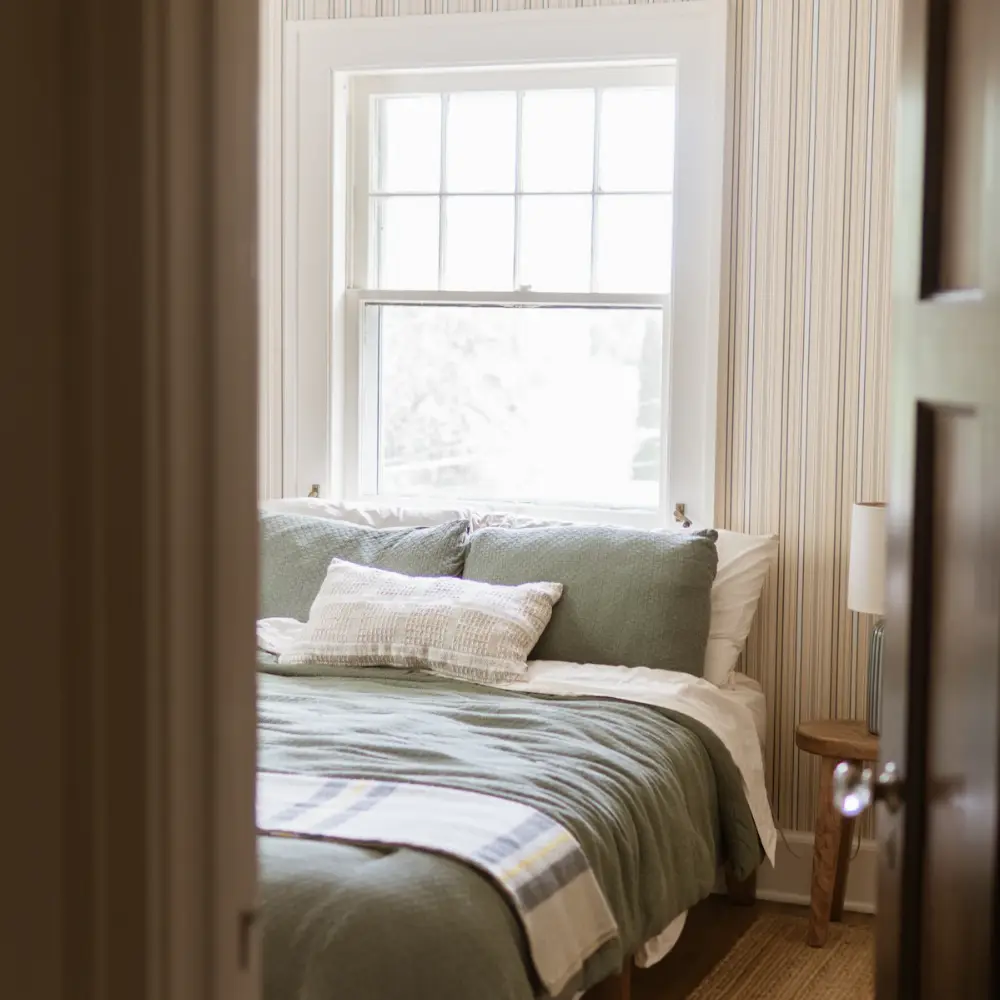
A sage green bedroom works almost anywhere, and the reason is boring. Sage sits between warm and cool, so neither light direction pushes it far from itself.
It is also muted rather than saturated, and muted colours behave better on large surfaces. A strong green on four walls becomes a presence in the room, which is the opposite of what a bedroom wants. A soft one recedes and lets the bed be the thing you look at.
Depth comes from everything except the walls
- Keep the woodwork a shade off the wall rather than brilliant white, since white trim against green sharpens the room and sharpness is not what mornings need.
- Put the warmth in the textiles. Linen in oatmeal, cream or a soft clay tone against green does more than any accent wall.
- Use one unpainted natural material, such as cane, oak or unglazed clay, to stop the scheme reading as a colour decision.
- Avoid grey. Grey next to green is what turns a calm room cold, and the two fight for the same quiet role.
Light the room for the slow part of the day
Green absorbs more light than pale neutrals, so a green bedroom needs more lamps than a white one to feel the same brightness. This catches people out after the paint is dry.
Two bedside lamps and one low light somewhere else is the working minimum. Warm bulbs, around 2700K, since a cool bulb over green reads clinical immediately. And keep the ceiling light for finding things, not for evenings.
The morning test
The point of the whole scheme is one specific moment, which is the first ten minutes awake with the curtains half open. In that light a sage green bedroom should look soft and slightly dim rather than bright and ready.
If the green you have chosen looks energetic at that hour, it is the wrong green for a room whose job is to let you wake up slowly. Go one step warmer and one step softer, and the room will do the work without being asked.
An editorial piece on colour, light direction and bulb temperature. Paint colours behave differently by brand, finish, window orientation and local light, so always test large samples in the actual room before buying.